


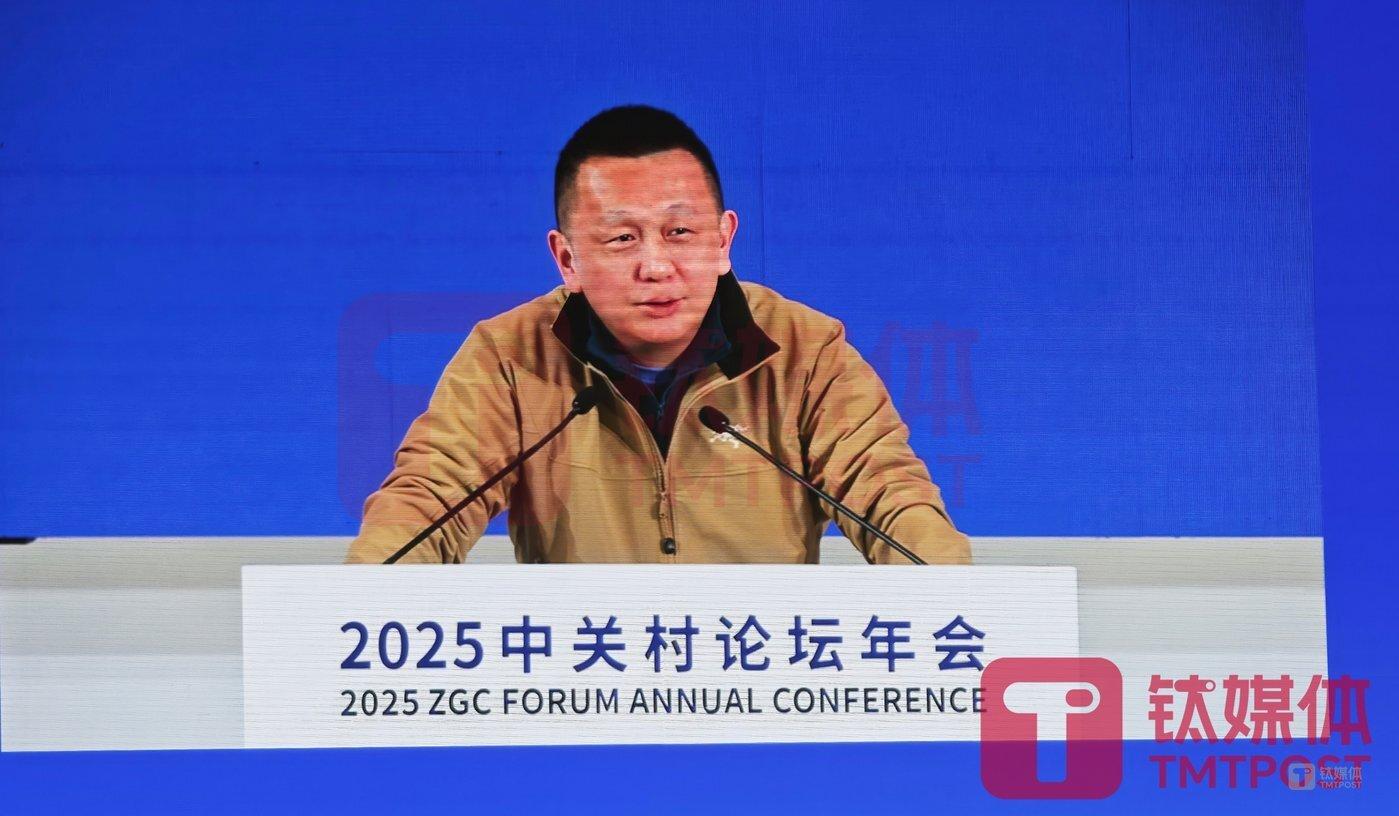
Zhu Xiaohu, managing partner at GSR Ventures
TMTPOST -- After the recent announcement of GSR Ventures' mass exit from humanoid robotics companies due to a lack of commercialization potential, Chinese venture capitalist Zhu Xiaohu, managing partner at GSR Ventures, has once again stirred debate in the AI industry.
Reflecting on China's internet and venture capital history, Zhu compared the current AI industry to past technology booms, saying that while AI is in its "valley of death," there is still hope. He cited Apple's flashy but commercially underwhelming AI efforts compared to Microsoft's successful monetization strategies.
Zhu made the remarks at the 2025 Zhongguancun Forum on Monday.
Zhu noted that in February 2020, software companies were hot commodities for Chinese investors. Today, he argues, AI software is experiencing a similar dawn, with many application-focused startups seeing explosive revenue growth. He claimed that in the past six months, numerous Chinese AI startups have reported over 10% weekly revenue growth and 20% monthly growth, likening it to the early-stage boom of the group-buying era.
However, Zhu controversially dismissed AI applications as mere "shell wrappers," emphasizing that true value lies in creating long-term competitive advantages through deep workflow integration, proprietary hardware, intellectual property, and specialized data. He stressed that AI-generated content (AIGC) should focus more on editing and delivery capabilities rather than raw generation.
Discussing open-source AI models, Zhu argued that its decision to prioritize ecosystem development over direct commercialization has allowed partners like Tencent to rapidly adopt and benefit from its advancements. He criticized startups attempting to train their own foundational AI models, calling it a waste of resources, and advised them to embrace open-source solutions like DeepSeek instead.
"AI applications have no inherent moat. If someone claims otherwise, they're misleading you. The real barriers must be built outside of AI itself," Zhu asserted.
Zhu also endorsed Circular Intelligence, a B2B software company backed by GSR Ventures and Moonshot AI co-founder Yang Zhijin, as an example of successful enterprise AI monetization.
His final advice for startups: Companies that fail to embrace AI will be left behind; startups should focus on niche applications with clear commercial pathways.
Beyond AI, Zhu reiterated his skepticism toward humanoid robotics, arguing that the market remains commercially uncertain. He pointed out that humanoid robots have traditionally been purchased by universities and competitors for research purposes, and recently, Chinese state-owned enterprises have started using them as display pieces.
"If a market lacks clear commercialization pathways and there is a strong consensus about its commercialization, it's usually time to exit," Zhu said, confirming that GSR Ventures has been withdrawing from early-stage embodied intelligence investments over the past few months, including firms like Flexiv, Songyan Dynamics, and Star Sea Graph.
Zhu's remarks sparked pushback from other investors. Zhang Ying, founding partner of Matrix Partners China, responded on social media, urging Zhu to reconsider, arguing that the robotics field is flourishing and that some market speculation is natural.
"In the long run, the humanoid robotics sector will see the emergence of big companies. After these comments, I wonder which quality robotics firms would even want to talk to him, let alone take his money," Zhang remarked.
Meanwhile, Gaocheng Capital founder Hong Jing noted that Chinese firms account for only 4% of global B2B software unicorns valued at over $10 billion, highlighting the challenging landscape for Chinese enterprise AI. Zhu, in turn, emphasized that true competitive advantages stem from tackling unglamorous but essential tasks. "The vast ocean will eventually turn red—dirty and labor-intensive work is the real moat," he said in an online post.
 快报
快报
根据《网络安全法》实名制要求,请绑定手机号后发表评论